
News
Adopting FHIR as the interoperability standard is now urgent
The race to adopt FHIR
Every current clinical interoperability standard will be deprecated abruptly over the next few years, and the race to adopt FHIR is accelerating.
FHIR as an interoperability standard
Fast Healthcare Interoperability Resources (FHIR) is an open interoperability standard that enables the exchange of medical information using current internet technology standards. It is now considered the future standard of clinical interoperability. FHIR is a standard, or communication protocol, in the same sense as other protocols in computing such as HTTP, FTP or TCP. In medical informatics there are protocols for standardizing communication between the different components distributed across or operating inside a healthcare facility — biomedical equipment manufacturers, clinical software vendors. A communication standard like FHIR unifies the language among all those actors, so that communication and interoperability are described by unified messages every actor can interpret. Other communication standards have been and continue to be used in medical informatics, such as DICOM and HL7.
Why is FHIR the future standard in medical informatics?
FHIR proposes a complete rethinking of how interoperability is built. Fundamentally, its structure for representing information is based on the notion of resources rather than documents, as in previous standards. Resources define any package of information relevant to the clinical context — patients, medications, physicians, procedures and so on — and they are easily interpretable by computers and comprehensible to humans. These resources have relationships or dependencies among them, and that creates a broad web of possible associations between those units of information, mirroring what exists inside a healthcare facility. What is genuinely interesting about this notion is that computing already had a way of representing this kind of structure, based on the object-oriented programming paradigm. That is decisive for usability: software developers, regardless of their expertise in medical informatics, are deeply familiar with this kind of representation. On top of that, the FHIR standard is supported by another communication protocol that modern technology vendors know well: RESTful. REST is a standard for building communication interfaces between software components over HTTP for accessing and interacting with data. These two premises — based on the notion of objects and supported by REST — resolve many of the limitations of earlier standards in medical informatics and maximize FHIR’s potential as the communication standard of the future.
How the FHIR standard evolved
-
FHIR was released as a draft and trial version in September 2013 by Health Level Seven International, a non-profit organization that proposes and defines standards for the healthcare sector. That version of the standard had 49 resources and focused on two use cases: creating personal health records and retrieving documents.
-
In 2015 the second draft of the standard was released. That version covered many more use cases. It introduced a metric for evaluating the maturity of each available resource, making it straightforward to assess the state of development, testing and validation of the new standard.
-
Version 3 of the draft standard was released in 2017, with substantial improvements to the clinical, administrative and financial resources.
-
In 2019 version 4 was officially released as non-draft, dropping the “for test use only” caveat. That meant the standard had reached a level of maturity broad enough to begin being used in production environments.
-
In 2020, the Office of the National Coordinator for Health Information Technology in the United States adopted FHIR version 4 as a requirement for Health IT certification.
-
In March 2023, version 5.0 of the FHIR standard was officially released. This new version included more normative content, with over 30 additional resources.
Challenges and benefits in adoption
The standard has reached a level of maturity sufficient to begin mass adoption globally. Version 4 has regulatory backing in the United States and has already been tested in production environments across the planet. Version 4B and the recently released 5.0 still have a lot to prove. Even so, it is clear that version 4.0 is being widely implemented today — see the chart below.
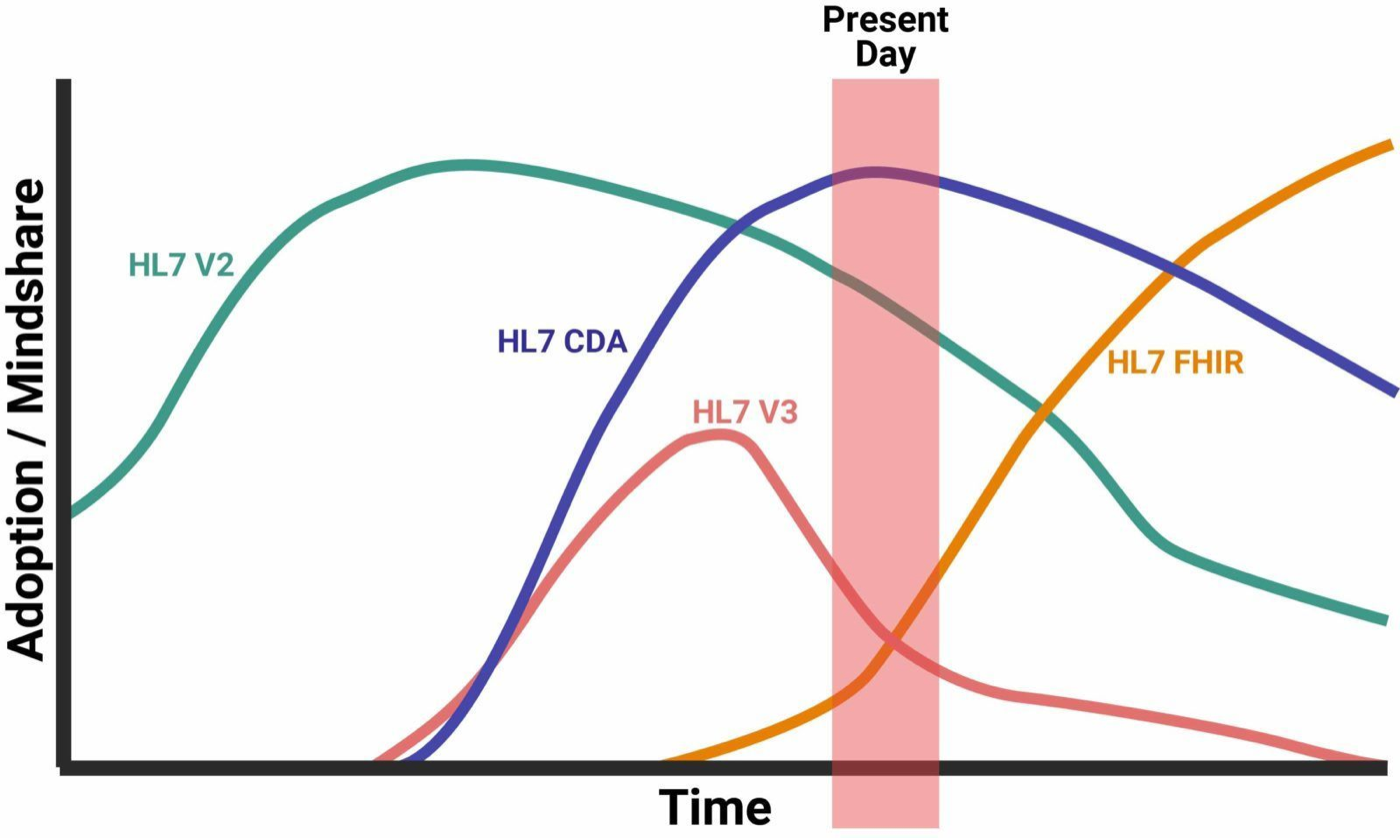
Mass adoption of standards in medical informatics. Image credit (Cabot)
Adopting FHIR is no longer a recommendation; it is a necessity. Manufacturers of biomedical components (hardware or software) will quickly stop adopting the earlier standards, and communication will unify around FHIR. For some years it will be necessary to support multiple communication standards — HL7 CDA, HL7 v2, v3 and FHIR — and those channels will have to coexist while support for the earlier protocols is deprecated. That is probably the biggest challenge facing manufacturers today: maintaining support for several channels and standards is expensive and limits scale. In this author’s personal opinion, the deprecation of the other standards will be abrupt, far faster than expected, quickly establishing FHIR as the single standard for interoperability and clinical information exchange. The advantages of FHIR are overwhelming compared to the alternatives — quick and easy to implement, a human-readable serialization format, no usage restrictions, a solid grounding in web standards, concise and easily understood specifications, ontology-based with formal mapping — and so FHIR arrived to solve a need that vendors in medical informatics genuinely felt. The future of clinical interoperability is here; FHIR arrived and it is staying.
Reference image taken from https://fire.ly/blog/what-is-fhir/