News
NOVA Disaster Recovery: a safeguard for medical images against catastrophe
NOVA Disaster Recovery: a safeguard for medical images against catastrophe.
More than 40% of small businesses never reopen after experiencing a disaster, and of those that do, a further 25% fail within the first year after the crisis

Disasters in the healthcare sector
A disaster in healthcare is any event capable of critically destroying fundamental parts of a clinical facility’s operational core. Natural disasters and terrorist attacks are two basic kinds of event that place the entire operational structure of any organization at critical risk. But technological evolution has built new horizons of application and new operational dependencies for organizations, and with them new points of failure that could put at risk the clinical facilities that depend on them. In the present day, many hospitals depend critically for their correct operation on the technology that manages, administers, structures and stores their information flows. In that sense, information systems are a new point of vulnerability in the face of disaster, and they are not necessarily exposed only to catastrophic events related to nature or physical terrorism.
Digital disasters in the healthcare sector
Cyberattacks are now a category of event that generates disasters within organizations. Clinical facilities, as explained above, depend fundamentally on information systems for the complete management of their organization; an interruption in their availability could collapse the entire operation and even put the organization’s existence at risk, after only a few hours of downtime. These downtime events are extremely costly in many cases and lead organizations to invest significant amounts of time and money recovering from the damage. Recent healthcare data breach statistics show that these breaches cost each organization in the United States an average of $10.1 million, according to IBM’s 2022 Cost of a Data Breach Report.
Healthcare providers store enormous quantities of protected patient information and need uninterrupted access to their information systems in order to serve their patients properly. Protecting those systems is therefore a task of maximum criticality — and one that is often poorly addressed. Recent examples of technology service downtime in the healthcare sector have been reported.
The Premera Blue Cross case
Premera Blue Cross is a health insurance company based in the United States. In 2014 it reported the exposure, unavailability and loss of sensitive information belonging to 11 million patients. The costs of that breach reached $74 million as settlement of a class action.
The Shields Health Care case
In May 2022, Shields Health Care Group, a Massachusetts-based medical imaging services provider, reported that its information systems had been accessed by unauthorized personnel. Protected information belonging to more than 2 million patients was exposed. The scope of the breach was massive, given that this provider supplies medical image management services to roughly 50 healthcare providers. The costs of that breach were never disclosed.
The importance of planning and prevention
To counter these potential disasters, healthcare organizations have to take proactive steps to protect and insure themselves. That includes implementing security procedures, training staff on technology assurance best practices, setting up replication and backups, and more. It is impossible to prevent 100% of the events that generate digital disasters; in this context, however, more is very much better. A prevention strategy should therefore cover every aspect within your organization’s reach, which will minimize risk and build resilience into your healthcare facility in the event of a catastrophe.
Enterprise Imaging and a disaster recovery strategy
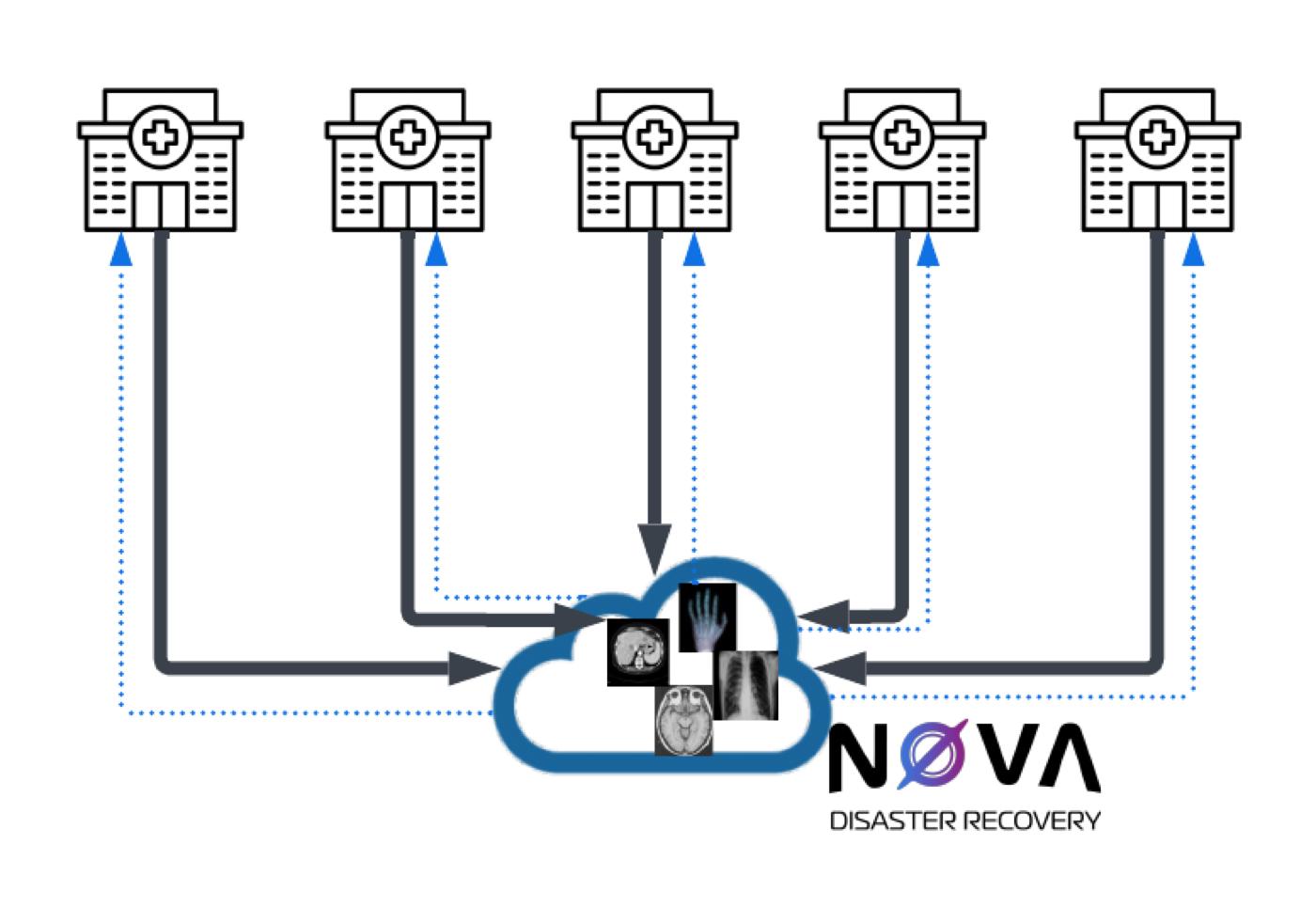
High-availability replication, snapshots and backups are three of the most commonly used strategies for securing information systems. Medical image management systems, however, have a particularity that limits these approaches: the sheer volume of information stored. An imaging center serving 20,000 patients could easily generate a terabyte of medical images every month. The three strategies above therefore run into a practical limit because of the high costs associated with storage. That means many image-based healthcare facilities have no disaster protection for their image-based information. This is why at NOVA Imaging we designed a solution that meets the assurance requirements needed to safeguard the operation of image-based care facilities in the event that their primary resource — the images — becomes unavailable. The solution is cost-effective and guarantees rapid recovery of imaging information in the face of catastrophic events. It is hosted in the cloud, with replication across multiple locations, which guarantees 99.999999999% access availability. This service is designed specifically for image-based clinical facilities whose technical operation is both on-premise and cloud — see the accompanying diagram — and whose imaging information is critical enough to require a guarantee of maximum availability in the face of disaster.