
Radiology
Patients are already reading their radiology report. What happens when they hand it to an AI too?
For decades, the radiology report was written mainly for another physician. That dynamic has changed: results portals let patients read the report directly, often before speaking to their treating physician.
And now there is an additional step. If they do not understand what they are reading, they can paste the report into a chatbot, ask for an explanation, and even turn to services that let them upload the images from a CT or MRI directly.
The technology opens an enormous opportunity to improve comprehension. But it also raises an important question: how far can you go in explaining, and at what point does clinical interpretation actually begin?
1. The radiology report now has a different reader
A 2026 piece in Clinical Imaging warns that immediate access to records created a new audience for the radiology report: patients who do not necessarily command the terminology physicians traditionally use with each other. Jargon, expressions of uncertainty and highly technical text can create confusion and even anxiety when read without professional guidance.
And this is not a hypothetical possibility.
A study published in Pediatric Radiology in August 2026 analyzed 391,713 studies performed at two academic hospitals. 50.5% of conventional reports were accessed through the portal by patients or family members.
The shift matters: delivering the result digitally no longer just means making access easier. It means the patient can become a direct reader of a document that was not originally designed for them.
2. Explaining better really can have a meaningful impact
The advantage of the new tools is clear when they are used to turn technical language into more understandable information.
A trial published by Radiology in November 2025 involved 200 oncology patients. Patients who received a simplified version of their CT report needed a median of 2 minutes to read it, compared with 7 minutes for the conventional report. They also reported significantly greater comprehension.
But there is one fundamental detail: the generated versions were reviewed by a radiologist before delivery, without exception.
Another study, in the Journal of the American College of Radiology in 2026, took the concept further. Instead of showing only the report, an application incorporated plain-language summaries, interactive terms and explanatory material. Self-reported comprehension among the 101 participants improved significantly, and almost half considered the summary the most useful tool. Again, the texts had been reviewed by professionals.
The opportunity seems evident: the technical report can remain intact while a second layer, written for the patient, is added alongside it.
3. But patients are already looking for that second explanation on their own
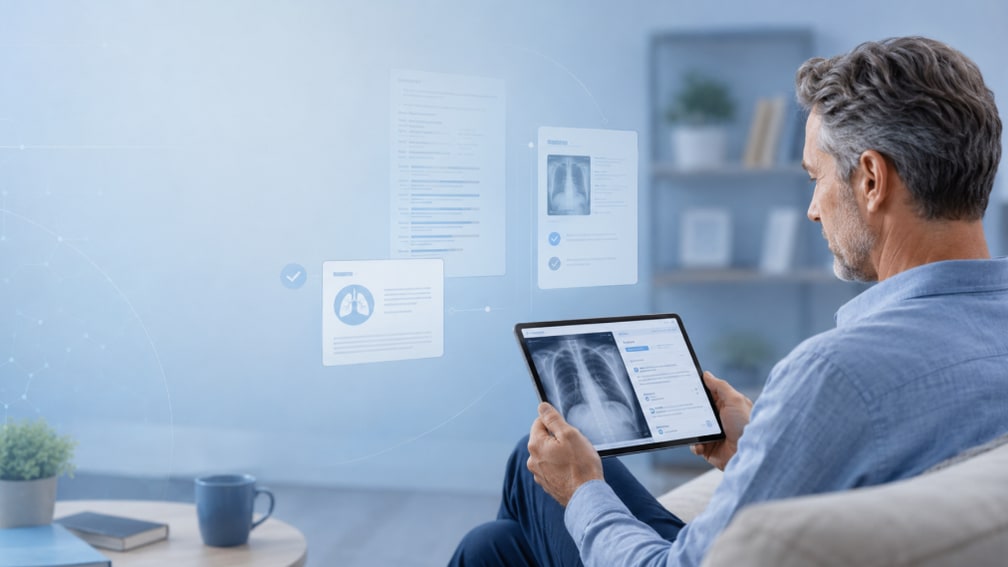
Healthcare institutions are not the only ones who can offer it.
A study in Insights into Imaging published in October 2025 took 100 radiology reports and fed them to ChatGPT, Gemini and Copilot with a deliberately simple question:
“Can you explain my radiology report?”
That is practically the behavior any patient might have.
All three models showed high overall correctness, though with significant differences in readability, level of detail, handling of uncertainty and recommendations. The best-performing model reached 89.6% on the comprehensibility metric used by the study.
This presents a different scenario from a few years ago. If a patient receives a result at 8 p.m. and their appointment is several days away, they can now get an almost immediate explanation.
And some users are no longer limiting themselves to the text.
4. From the report to the DICOM: a behavior starting to appear
There are as yet no good population studies that would let us say what percentage of patients are sending their DICOM images to AI systems. There is, however, observational evidence that it happens.
In July 2026, the ReadYourLab platform published aggregated data on 1,815 CT and MRI studies voluntarily uploaded by users in the United States and Canada to receive AI-generated explanations.
Among those users, 44% uploaded the images within the first three days after the study, and 12.9% did so the same day. In addition, 60.5% of paying users asked at least one follow-up question, with an average of 5.4 questions among those who continued the conversation.
The figure has to be read correctly: this is information published by a commercial platform, drawn from a self-selected population; it does not demonstrate that 44% of radiology patients use AI.
What matters is something else. It demonstrates that a behavior already exists in which the patient takes their original DICOM files, carries them outside the ecosystem where the study was performed, and seeks a second technological explanation.
5. The problem appears when we move from explaining to interpreting
Not all questions carry the same difficulty.
“What does pulmonary nodule mean?” is a fundamentally educational question. “Does that nodule mean I have cancer?” is a clinical one.
A study published in 2026 evaluated 12,000 responses generated by three models from questions related to radiology reports. When the task was explaining terminology, accuracy reached 98.1%. When the question required interpreting the degree of diagnostic confidence, it fell to 82.3%.
There is also a less obvious risk: the confidence with which an answer is presented.
The same work identified 131 responses containing clinically significant errors. Depending on the model, between 61.5% and 100% of those errors were delivered with a self-reported confidence of 8/10 or higher.
That is one of the principal limitations of these technologies: an answer can be wrong and still sound perfectly convincing.
Even in the Radiology trial where simplification produced excellent results, professional review detected factual errors in 6%, omissions in 7% and inappropriate additions in 3% of the generated versions.
Simplifying, then, is not the same as diagnosing.
6. Technology can accompany the patient. Context still belongs to clinical care

The power of these tools should not be downplayed. They can translate complex terms, summarize a report, help formulate questions and help a patient arrive better prepared for their appointment. Recent evidence shows there is real potential to improve comprehension.
But the treating physician has elements that are normally absent when a patient pastes a report into a chatbot: symptoms, physical examination, history, medications, labs, clinical course, pathology and prior studies.
That context can completely change the meaning of a radiological finding.
Patients’ own perception seems to point toward a model of complementarity. A review in Academic Radiology published in 2026 brought together 18 studies from 11 countries and 6,574 patients. While it found interest in AI tools, it also identified a clear preference for maintaining human oversight and using the technology as support, not as a substitute for the professional.
The challenge, then, does not appear to be preventing patients from using technology. It is probably offering them something better.
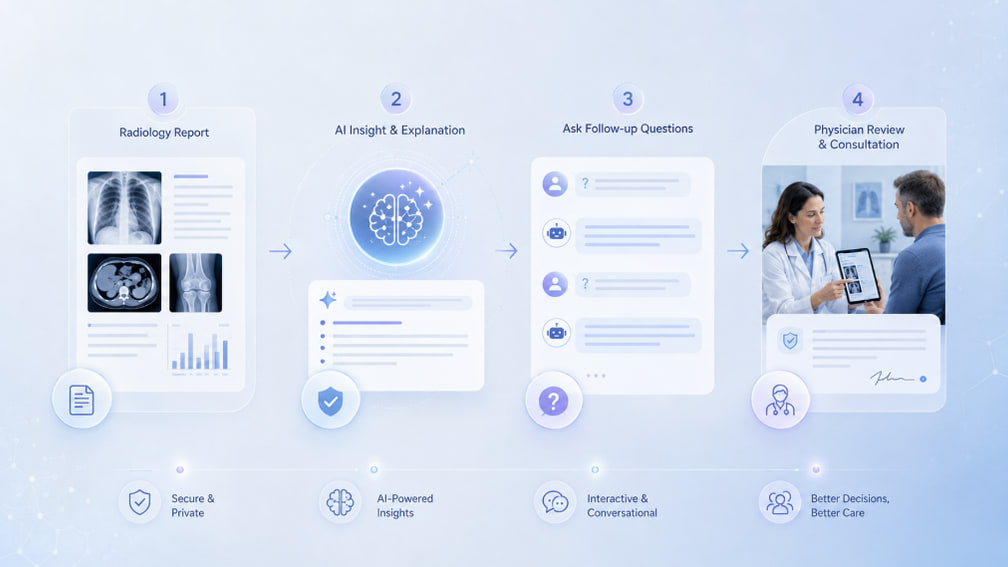
A results portal could evolve from simply displaying a PDF toward offering plain-language explanations, contextualized definitions and comprehension tools linked to the original report — always keeping the medical document visible and clearly distinguishing educational explanation from clinical interpretation.
In a 2026 JACR study, presenting each sentence of the report alongside its explanation produced 2.31 times higher odds of objective comprehension than simply offering a glossary of terms.
That approach may be particularly interesting for the future of RIS/PACS systems and patient portals.
More access demands better communication
Technology has already made it possible for patients to access their results almost immediately. Now it is making something even more far-reaching possible: interacting with them.
The challenge is not to deny that reality, nor to assume that every technological explanation represents a risk. Recent data shows real benefits in comprehension, accessibility and patient engagement.
But it also shows an important limit.
Technology can help someone understand what a report says. The treating physician remains fundamental to understanding what that result means for that patient.
Perhaps the next evolution of digital radiology is not delivering more information. It is delivering it with better context.
Sources
The references used were published between October 2025 and August 2026: Radiology (RSNA), Insights into Imaging, Clinical Imaging, Journal of the American College of Radiology, Academic Radiology and Pediatric Radiology. For the direct DICOM upload behavior, the observational report The Patient Second Read, from ReadYourLab Research (July 2026), was additionally used and is expressly identified as a non-peer-reviewed source.
The NOVA Imaging patient portal delivers results and images through a secure link, with an AI agent that explains the report in plain language without replacing the signed document or the treating physician. You can see how it works on the patient portal page or message us on WhatsApp for a demonstration.